

Use your HSA for current medical bills if paying from other savings would weaken the cash you need for essentials and emergencies. Invest only the portion you can leave alone through a market decline. I’d give the dollars separate jobs rather than choose between an all-spending account and an all-retirement account.
The federal benefits are worth preserving: contributions can receive favorable tax treatment, earnings aren’t taxed inside the account, and qualified withdrawals are tax-free. But paying a medical bill with HSA cash isn’t wasting those benefits. It’s using the account for its intended purpose.
Start with the medical bill, not the investment menu
Imagine I’m opening a $900 medical bill with the HSA investment screen beside it. My savings look adequate, until I subtract next month’s rent and the car repair already booked. That shiny investment button is answering the easy question, which irritates me. I leave the bill money in cash. Only the remainder gets considered for retirement.
Your deductible is a starting point, not necessarily the most you’ll owe. One documented 2026 self-only plan has a $4,000 deductible, 20% coinsurance, and a $6,300 in-network out-of-pocket limit. Covered bills can continue after the deductible. Premiums, noncovered services, and charges excluded by the plan don’t become covered simply because you reach that limit.
Let’s begin with what you expect to spend then decide how expensive of a year you want cash to cover. Don’t include routine spending if it’s already accounted for in your expensive year cash calculation. The other half of this calculation is less glamorous. Consider how much outside cash is available after protecting your rent, job interruption and other expenses you have already committed to.
For your medical exposure consider your remaining deductible, out-of-pocket limit, expected prescriptions and procedures and whether individual or family limits apply. Timing is also important; cash which covers the rest of the year may not cover the fresh deductible in January if your plan year ends in December.
Two $8,000 HSAs, two reasonable answers
Two hypothetical households are similar. Each has self only coverage and expects to spend $1,800. They choose to fund a $6,300 covered stress year. Each shields $6,000 outside the HSA for other household expenses. Assume the custodian Cash Floor is $1,000. That’s an example of a term the account offers, not a requirement.
| Cash and investment calculation | Household A | Household B |
|---|---|---|
| HSA balance | $8,000 | $8,000 |
| Outside cash before commitments | $7,000 | $13,000 |
| Outside cash after protecting $6,000 | $1,000 | $7,000 |
| Household HSA cash need | $6,300, $1,000 = $5,300 | max($6,300, $7,000, $0) = $0 |
| HSA cash retained, including illustrative $1,000 floor | $5,300 | $1,000 |
| Potentially investable remainder | $2,700 | $7,000 |
| Investment value after a hypothetical 30% decline | $1,890 | $4,900 |
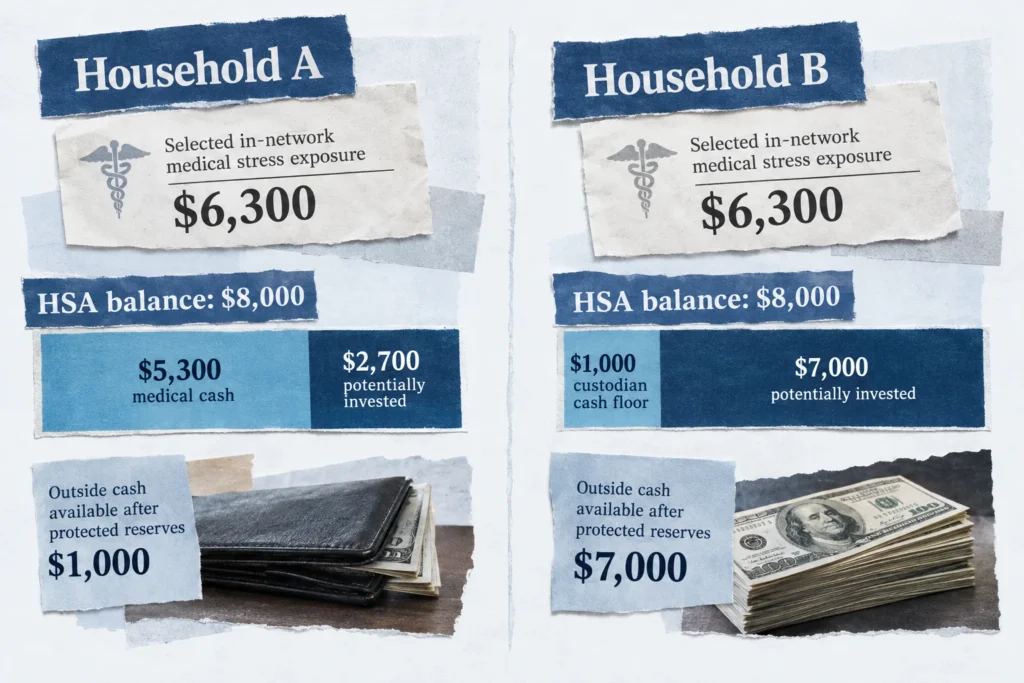
Even after that investment loss, either household can still pay for the chosen medical exposure from cash, as long as the outside money is available. That’s what matters to me. Spotting tax advantages has nothing to do with it. Household B just has more available cash. Neither allocation covers every single medical expense.
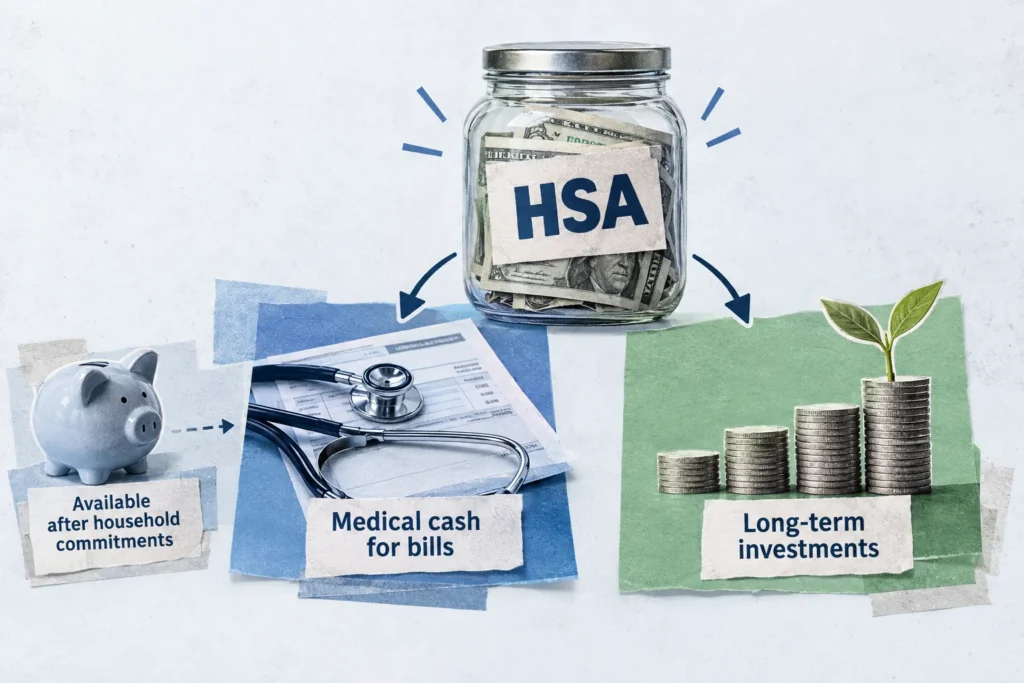
If your HSA cash need exceeds your account balance, keep the money liquid and figure out how you will pay the next medical expense. The custodian’s cash floor may exceed your account balance. It may be that you are unable to invest through that custodian. A low minimum doesn't always mean you can afford to invest.
Small balances feel fees more sharply
The charges for services HealthEquity lists can be broken out and charged separately. HealthEquity also lists a 0.03% investment advisory charge, capped at $10, which comes out to roughly 0.36% per year before the expense ratio of the funds, or $9.72 on $2,700 and $25.20 on $7,000. Review your account terms to see what services are included, as your terms may be different from HealthEquity.
A flat fee tells a different story. Fidelity advertises no investment minimum for its self-directed HSA, but some employer arrangements may pass through a recordkeeping fee of up to $48 annually. If you pay the full $48, it consumes 4.8% of a $1,000 balance versus 0.48% of $10,000. These are different example fees and providers, and neither of them include all potential fees.
Automatic cash replenishment is worth checking as well. HealthEquity’s Cash Replenish feature sells investments to restock cash. This would continue payments, but it could sell after a drop. I’d rather strategically size the medical reserve to cover anticipated cash flow needs than have payments automatically sell shares to determine which dollars become cash.
Saved receipts preserve an option
If payments outside the HSA wouldn’t reduce your household cash reserves, you could keep the option to reimburse yourself at a later date. There is no timeline set by the feds, but the expense must be eligible, occur after the HSA was created, and not previously been reimbursed or taken as an itemized deduction. Just because you have an old receipt, doesn’t mean you get a tax free withdrawal.
I’d keep one ledger that links each expense to its evidence. The ledger should show the service date, patient, what the expense was for, and how much was paid after insurance. The ledger should also show if the expense occurred after the HSA was opened, if any amount was previously reimbursed, and when the reimbursement occurred. You should keep the itemized bill, EOB, and other evidence to show what was actually paid vs billed.
A documented $1,200 eligible payment supports up to $1,200 of later reimbursement, less anything already reimbursed, not $1,200 plus investment growth. You still need enough account value to pay it. I like the flexibility saved records offer, but they aren’t a substitute for cash you need promptly.
Contribution rules and spending rules aren’t the same
Be sure to check your eligibility to contribute before you add new money to your HSA. Generally, you will need qualifying health coverage, no disqualifying other coverage, no Medicare, and you cannot be claimable as another person’s dependent. A general-purpose health FSA, including a spouse’s that covers you, will also disqualify you. Starting in 2026, special rules expand HSA treatment to individual-market bronze and catastrophic plans, but the other eligibility conditions still apply.
Here’s the welcome distinction: losing contribution eligibility doesn’t take away your existing HSA. You can keep it and take federally tax-free distributions for qualified expenses, generally including eligible medical costs for you, your spouse, and qualifying dependents. Insurance premiums generally don’t qualify. Exceptions include COBRA, certain coverage while receiving unemployment compensation, eligible long-term-care premiums, and qualifying Medicare premiums once you’re 65, but not Medigap.
Nonqualified withdrawals are subject to ordinary income tax and an additional 20% federal tax. At age 65, the additional tax disappears, however, the income tax still applies. The additional 20% federal tax disappears with disability and death. Turning 65, however, doesn’t guarantee tax-free withdrawals.
The tax advantages at the federal level do not apply to the state level. California’s 2025 filing instructions require HSA contribution adjustments. They do not shelter account earnings as the federal rules do. If that treatment applies to you, keep investment records for state reporting as well as medical records. You may want to use the tax year rules and instructions rather than assume the treatment applies.
I’d consider returning to the HSA split if you become disabled, schedule a procedure, lose income, or use up emergency savings. Those events will give you cash to cover medical costs. HSAs are intended to cover medical costs. Using it for healthcare costs doesn’t mean you have given up on contributing to your HSA. Leaving the long term investment portion of your HSA untouched, is an opportunity to benefit from healthy, long term growth.
Sources and references
- Internal Revenue Service: Publication 969 (2025)
- Internal Revenue Service: Instructions for Form 8889 (2025)
- Internal Revenue Service: Notice 2004-50, Q&A 39 (2004-08-16)
- Internal Revenue Service: Notice 2026-5
- Memorial Hermann Health Plan: 2026 Select 4000 HSA HMO Summary of Benefits and Coverage
- U.S. Securities and Exchange Commission: Health Savings Accounts (HSAs), Investor Bulletin
- HealthEquity: HealthEquity HSA Investment
- Fidelity Investments: Fidelity HSA fees and minimums
- California Franchise Tax Board: 2025 Instructions for Schedule CA (540)