

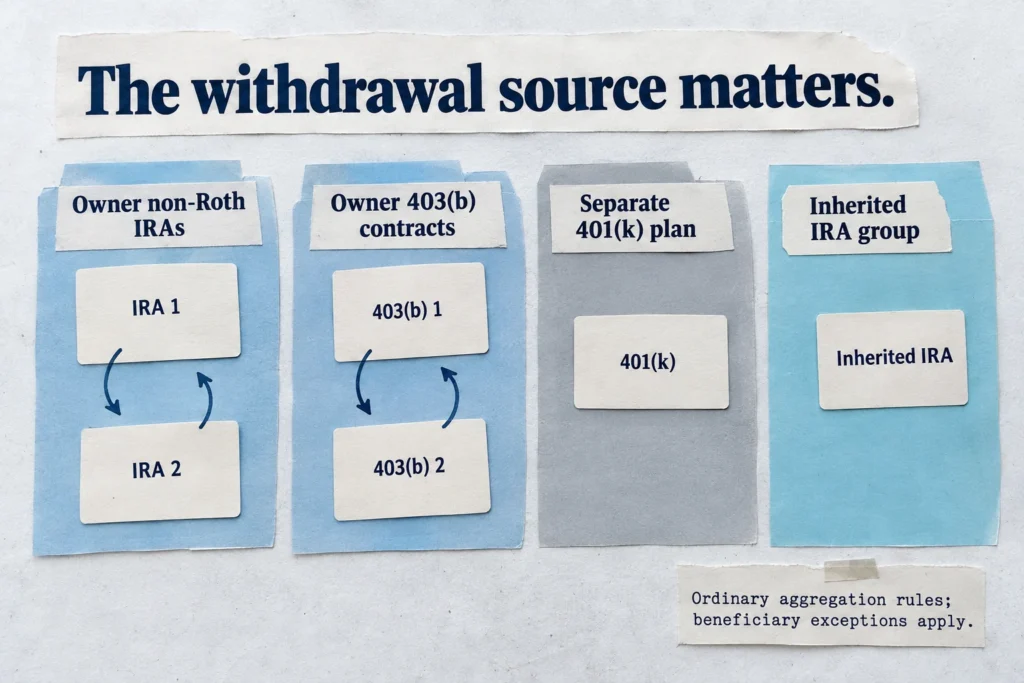
Yes, often. You can determine your traditional IRA RMDs separately, and then withdraw the total amount from one or more of your eligible owner IRAs. The same aggregation permission applies to your 403(b) contracts, but an IRA withdrawal can't be used to satisfy a 401(k) RMD, and your spouse's withdrawal can't be used to satisfy yours.[1][2][4]
Generally, I would sort the accounts before deciding where to withdraw. Using one convenient IRA can save you from making multiple trips, but only if it’s in the right group.
Picture me in an imagined year-end paperwork session, juggling two IRA statements and an old employer’s plan notice. I’ve circled the household withdrawal total and have started putting the papers away, when I see “amount remaining” on the employer’s plan notice. Haven’t I taken enough? Annoyed, I pull the statements back out and put them in order by account type. The total answered the wrong question.
Which accounts can share a withdrawal?
| Account type | Calculate the requirement | Where the withdrawal can come from |
|---|---|---|
| Your traditional, rollover, non-Roth SEP, and non-Roth SIMPLE IRAs | Separately for each IRA | One or more eligible non-Roth IRAs you own |
| Your 403(b) contracts | Separately for each contract | One or more eligible 403(b) contracts you own, not an IRA |
| Separate 401(k), 401(a), or 457(b) plans | Separately for each plan | The particular plan that owes the RMD |
| Inherited non-Roth IRAs | Separately for each inherited IRA | Eligible inherited non-Roth IRAs held by the same beneficiary from the same deceased owner |
| Inherited Roth IRAs | Apply beneficiary distribution rules separately | Eligible inherited Roth IRAs from the same deceased owner; not inherited non-Roth or owner IRAs |
| Your spouse’s accounts | Under your spouse’s own requirements | Your spouse’s permitted account groups, not yours |
| Your own Roth IRA or designated Roth workplace account | No lifetime owner RMD | A Roth withdrawal does not satisfy a non-Roth account’s RMD |
You’re combining permission to pay, not skipping calculations. First, work out RMDs for all eligible IRAs and then combine the totals. The same rule applies to 403(b) contracts. Separate 401(k) plans require separate distributions, not one combined withdrawal that includes all the mutual funds in each plan.[1][2]
I wouldn’t rely on a simple statement-balance calculation if you have separately tracked pre-1987 403(b) accruals or an annuitized contract. Special rules apply to those plans for the timing of Required Minimum Distributions, and some annuities may require special treatment. The answer to the questions “Which balance is subject to this year’s RMD? And how do my annuity payments count?” may require a different analysis than what you have identified to be the correct withdrawal group.[3][7]
Enough withdrawn, but $3,000 still due
Consider a hypothetical 2026 household. Alex turns 74 and uses the Uniform Lifetime Table’s 25.5 divisor. Two owner IRAs had December 31, 2025 balances of $153,000 and $102,000, producing RMDs of $6,000 and $4,000. Alex may take their combined $10,000 from either eligible IRA. The other requirements below are stipulated confirmed amounts, including the inherited IRA’s $2,000; that inherited amount is not calculated using Alex’s owner-IRA divisor.[1][3]
| Obligation group | Required | Distributed | Still due |
|---|---|---|---|
| Alex’s two owner IRAs | $10,000 | $14,000 from one IRA | $0 |
| Alex’s 401(k) | $5,000 | $4,000 | $1,000 |
| Alex’s inherited traditional IRA | $2,000 | $0 | $2,000 |
| Jordan’s owner IRA | $3,000 | $3,000 | $0 |
| Household total | $20,000 | $21,000 | $3,000 |
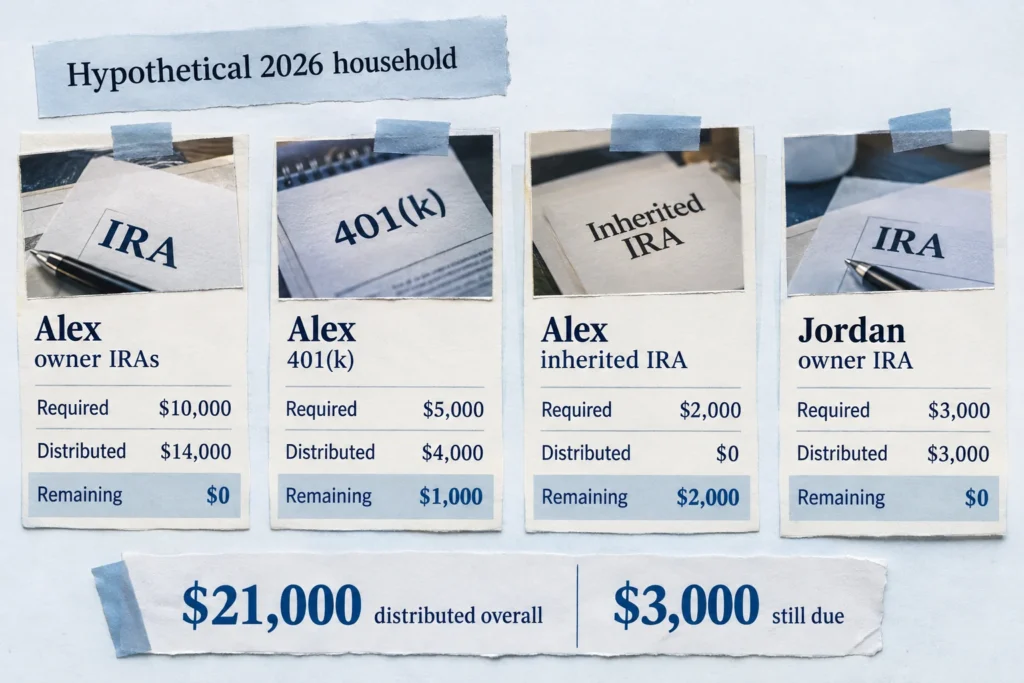
The last row is the trap. Withdrawing $21,000 against $20,000 Required Withdrawal seems correct. It’s not. Alex’s $4,000 from Owner IRA cannot be distributed to satisfy the missing $1,000 from the 401(k) or $2,000 from the Inherited IRA, and Jordan’s distribution is for Jordan’s satisfaction. Alex must still take the $1,000 from the 401(k) and the $2,000 from the Inherited IRA.[1][2][4]
I'd prefer to catch this before taking more withdrawals than necessary. A compliant $20,000 arrangement would include $10,000 from the eligible owner IRAs of Alex, $5,000 from Alex’s 401(k), $2,000 from Alex’s Inherited IRA, and $3,000 from Jordan’s IRA. After the illustrated withdrawals, the remaining $3,000 still needs to come from the correct accounts. The excess IRA withdrawal also doesn’t count toward the next year’s RMD.[1][4]
Inherited accounts need their own labels
As for inherited IRAs, I'd put the deceased owners name right on your ledger label. Eligible inherited traditional IRAs you hold from the same person can share withdrawals after you calculate their requirements separately. One from your mother cannot join one from your father, and neither can join your own IRA. Keep inherited Roth IRAs separated from inherited non-Roth IRAs. This allows you to take withdrawals from different accounts, not alter the beneficiary’s payout deadline.[3][4]
A surviving spouse's valid election to treat an inherited IRA as their own changes which group the IRA is in. Until that happens, inherited IRAs are treated the same. Marriage does not allow you to take withdrawal from your spouse's IRA, and vice versa.[4]
Match your ledger to completed withdrawals
I prefer the ledger above because it provides you something more valuable than reassuring household total: the amount still owed by each group. Your custodian may not have the whole picture. A Fidelity 403(b) notice, for example, explicitly limits its calculation and distribution to its account and not to your outside contracts.[6]
Maintain an account-level sheet behind that summary. For each account include the owner or beneficiary, type of account, deceased owner if any, prior December 31st balance, calculated RMD, and deadline. Give the group label such as "Alex owner IRAs", "Alex 403(b)s" or "Alex inherited Traditional IRAs, Mother". Each separate employer plan gets a separate group label. This allows you to trace back the combined requirement to the individual calculations, instead of trusting the total that you may not be able to reconstruct.[1][2][4]
Enter the date, actual source account, gross amount, withholding, and confirmation number once the withdrawal is complete. Attach each outside withdrawal to its source account only once. For each permitted group, subtract qualifying gross distributions from the combined requirement, and stop at zero. Don’t take a surplus into another group. An RMD estimate is not a completed transaction.[1][2][4][5]
Use the gross amount when determining your RMD. The net amount (after withholding) shown on your checking account is irrelevant. For example, if $5,000 is distributed with $1,000 withheld, you would need to take $5,000 for RMD purposes, as you would only receive a net of $4,000. There may be instances where the total distributions for the year on your statement are higher than the RMD distributions.[4][5]
Ask your provider, “Which account supplied this gross distribution, has it completed, and does your remaining-RMD display include any outside accounts”? Compare the answer to your confirmation and ledger. If a group still shows an amount due, request that amount, not just the easiest account to access.[1][5][6]
If the deadline has already passed, correct the shortfall promptly and address Form 5329 reporting and possible relief. A missed RMD can trigger an excise tax, and a late withdrawal alone does not guarantee a waiver.[1]
Sources and references
- Internal Revenue Service: Retirement plan and IRA required minimum distributions FAQs
- Internal Revenue Service: RMD comparison chart (IRAs vs. defined contribution plans)
- Internal Revenue Service: Publication 590-B (2025), Distributions from Individual Retirement Arrangements (IRAs)
- Office of the Federal Register and Government Publishing Office: 26 CFR § 1.408-8, Distribution requirements for individual retirement plans
- Fidelity Investments: RIA Statement FAQ
- Fidelity Investments: Action required: Take your annual required minimum distribution
- Internal Revenue Service: Publication 571 (01/2026), Tax-Sheltered Annuity Plans (403(b) Plans)