

Appreciated shares that are donated to a charity can be more beneficial than selling the shares and donating the cash. The benefit occurs because the charity receives the shares at their current fair market value. Then, there is no need to recognize the gain of the sale.[1][2]
You can claim a charitable deduction for a donation regardless of whether the shares were sold and the cash given or the shares were donated to the charity. For smaller gifts, the 2026 cash-only charitable deduction for non-itemizers can make cash the better choice.[1][3]
Give the charity the same amount in both comparisons
Suppose your planned 2026 gift is $10,000. You can transfer publicly traded stock worth that amount or sell the same stock and give $10,000 cash. In this hypothetical example, the shares cost $4,000, you’ve held them more than one year, and the recipient is a qualifying public charity that gives you nothing in return.
For the arithmetic, assume $200,000 of AGI before the sale, enough other deductions to itemize without this gift, a 24% marginal deduction benefit, and a 15% long-term capital-gain rate. You have no other charitable gifts or carryovers, and neither gift hits its deduction ceiling. We’re leaving out state taxes, net investment income tax, loss offsets, fees, and other income-sensitive effects, but not the 2026 charitable floor. Itemizers generally deduct only contributions exceeding 0.5% of AGI, and selling the stock raises that floor slightly.[1][2][4]
| Calculation | Transfer shares directly | Sell shares, give cash |
|---|---|---|
| Charity receives | $10,000 | $10,000 |
| Realized capital gain | $0 | $6,000 |
| Capital-gain tax at 15% | $0 | $900 |
| AGI | $200,000 | $206,000 |
| Charitable floor: 0.5% of AGI | $1,000 | $1,030 |
| Deductible gift after floor | $9,000 | $8,970 |
| Deduction tax benefit at 24% | $2,160 | $2,152.80 |
| Modeled after-tax cost | $7,840 | $8,747.20 |
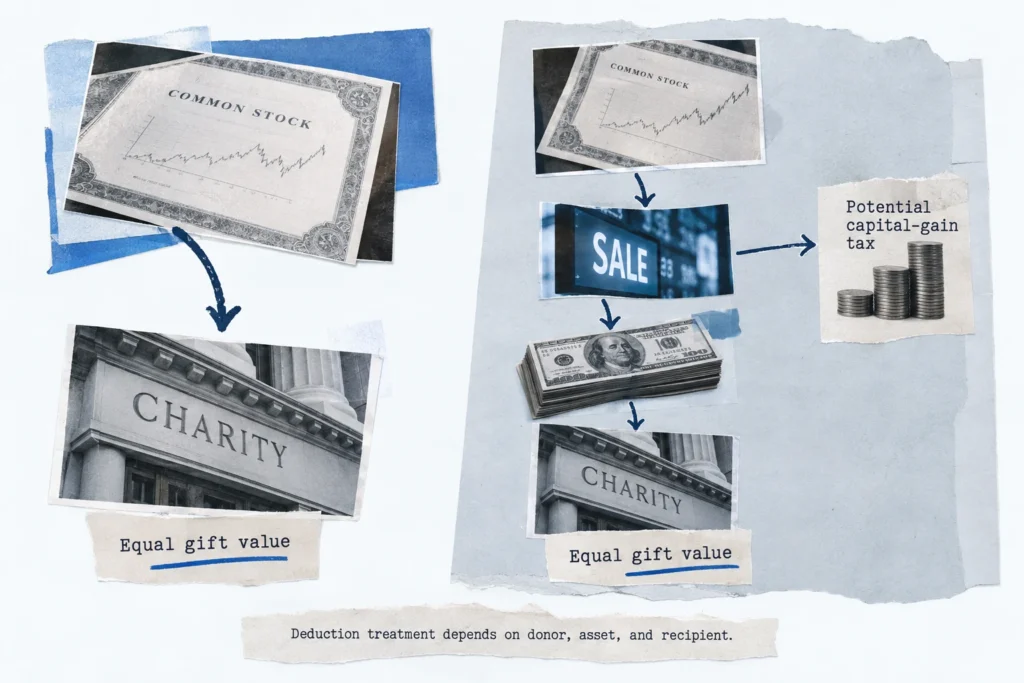
The stock gift results in a $907.20 benefit: a $900 reduction in the capital gains tax and a $7.20 increase in the deduction from the stock gift. I’d be leery of an approach that adds the $2,160 to the $900 savings from the capital gains tax. The cash gift is also deductible. Neither deduction compensates you for the gift.[1][2]
Pay with existing cash and hold the stock, and there is no current sale tax to avoid. A gift of stock removes the stock’s embedded gain from your portfolio. I can’t place a reliable present value on that benefit without knowing when you’d sell the stock. Also, you end up holding different assets. A gift of stock preserves cash, and a cash gift preserves stock.[1]
A small gift can produce a different winner
A deduction isn't needed for shares to help. Take a $1,000 gift of ordinary stock, held more than 1 year, with a $200 basis, to a qualifying public charity. Assume you already itemize, have an AGI of $300,000 before any sale, make no other gifts, and receive no benefits in return. The charitable floor is $1,500, which is greater than either of the gifts. At a 15% gain rate, selling would give a $120 tax benefit. Giving the stock to the charity avoids that $120 tax benefit, with no deduction. All of the above is also true with loss-offsets, additional taxes, fees, and thresholds.[1][2]
Let's say you're an eligible non-itemizer with unused cash-deduction room in 2026. Qualifying cash gifts up to $1,000 (or $2,000 if married filing jointly) are deductible. Share gifts and donations to DAFs do not qualify. With an assumed 24% benefit, the $1,000 cash gift saves $240. Sell the stock, pay the $120 gain tax from other funds, and give the charity $1,000. The modeled cost is $880. The cost to give the $1,000, with no deduction, is $1,000. Cash is $120 better because the gain did not disappear, but because the cash deduction was worth more.[1][3]
For your own gift, I’d compare the tax bill with and without the donation rather than multiply its value by your headline bracket. Near the standard-deduction crossover, only part of an itemized gift may add a benefit. And for taxpayers reaching the top bracket, the 2026 overall itemized-deduction limitation can reduce the marginal benefit to 35% rather than 37% in the fully affected range.[1][2]
The holding period and recipient change the deduction
The lot matters more than the ticker. Ordinary purchased investment shares held more than one year generally qualify for a fair-market-value contribution amount when given to a qualifying public charity. For appreciated shares held one year or less, you generally subtract the appreciation, leaving basis rather than current value. The date you first bought the company doesn’t establish the holding period of every share you own.[1]
A large gift can also outrun the deduction you can use this year. Typical public-charity cash gifts have a 60%-of-AGI ceiling, versus generally 30% for long-term capital-gain property deducted at fair market value. Qualifying excess contributions generally carry forward for five years. You can’t simply add those ceilings together, and amounts excluded by the 0.5% floor don’t automatically carry forward.[1][4]
I’d check the recipient’s tax classification before borrowing any of the public-charity arithmetic. Certain private nonoperating foundations generally require reducing appreciated-property gifts to basis, with a 20% ceiling for capital-gain-property gifts. Qualified appreciated stock can escape the basis reduction, but that exception has conditions, including a family contribution limit. A charity’s willingness to accept your asset doesn’t establish its deduction treatment.[1][4]
The transfer has to deliver the intended shares
Imagine I’m filling out a year-end gift form, with my lot records open in another tab. You enter the share count and ticker symbol, then near skipping the acquisition date. The default-lot warning catches your attention. Thank goodness! All that math, and you have not specified which shares the broker should send. You go back to your records, and identify the intended lot, and submit the form.
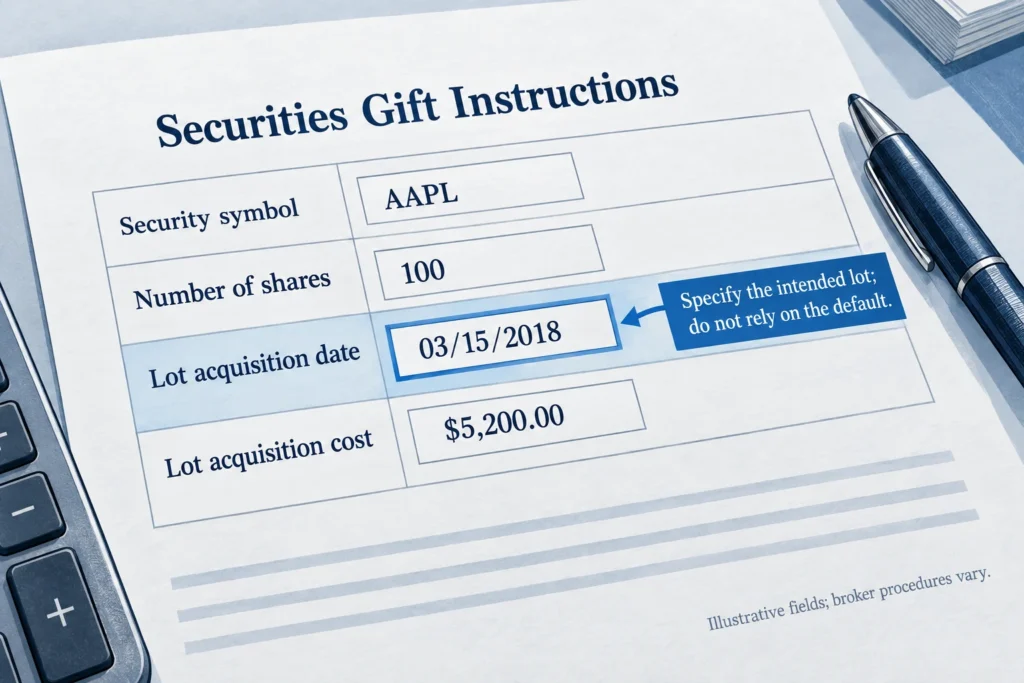
I’ve imagined the scene, but the form is real. The Fidelity external gift form, for example, asks for your acquisition date and cost, and states its default disposal method would apply if you do not provide an acquisition date. It states you should submit the form at least 2 weeks prior to the deadline, but that doesn't guarantee it would be processed by then. So be clear and concise when matching your instructions: intended lot, share count, basis and holding period.[7]
Get the receiving instructions and confirm the charity is set up to accept your security. The processing time for mutual funds can be longer than for a standard stock transfer. The Red Cross estimates that some fund companies can take three to six weeks to set up a receiving account, and that mutual funds may take longer to process than stocks. Keep proof of your request, not just the request itself. A requested share amount can change value in transit, so your recorded gift may not match your estimated gift.[5][8]
Keep valuation and acknowledgment separate
Stock sell proceeds don't give you a shortcut for valuation. The average of the high and low selling prices of the stock on the valuation date is used to determine fair market value for stocks, and other methods may apply to other securities. For actively traded public stocks, the IRS may allow the use of the average of the high and low prices of the stock on the valuation date, but be sure to keep the price quotations and evidence of calculation in your files, and report the valuation in a manner that you can explain.[5]
The acknowledgment does a different job. For a deductible gift of $250 or more, it must describe the property and address whether you received goods or services. It needn’t state the property’s value, that remains your responsibility. Obtain it by the earlier of filing your return or the filing deadline, including extensions. Individuals generally also file Form 8283 when total claimed noncash deductions exceed $500.[5][6]
Securities traded on an exchange complete Section A of Form 8283 for donations over $5,000. They do not require a qualified appraisal for this section. Other property over $5,000 requires a qualified appraisal to complete Section B. It is subject to aggregation and exceptions. Cryptocurrency and closely held interests do not qualify for the public security exception and should not be given the shortcut just because they may have a quoted market price. When required, the qualified appraisal generally must be signed no earlier than 60 days before the gift and received by the applicable return deadline.[5][6]
Look at the portfolio you’ll still own
I especially like a share gift that trims a position you already wanted to reduce. In a hypothetical $200,000 portfolio, a $60,000 stock holding is 30%. Donate $10,000 of it and you’re left with $50,000 in a $190,000 portfolio, or 26.3%. That’s less concentration, not its disappearance. Give away a diversified holding instead and the concentrated stock could become a larger share of what remains.
For your planned gift, look at the two funding options side-by-side: Tax-triggered gifts allow you to realize a current tax deduction and leave the remaining investments. If the tax saving and the investment alignment are aligned for shares, the paperwork can earn its keep. If the deduction gets better treatment for cash and the asset can’t be delivered to the charity or the gift can’t be completed in time, I’d recommend making a checkbook gift. The tax arrangement should align with your philanthropic intent, not overshadow it.
Sources and references
- Internal Revenue Service: Publication 526 (2025), Charitable Contributions
- Internal Revenue Service: Publication 505 (2026), Tax Withholding and Estimated Tax
- Internal Revenue Service: Publication 6196, Charitable Contribution Deduction Tips for Non-Itemizers (2026-10)
- Internal Revenue Service: Publication 5464, Exempt Organizations Technical Guide 58, revision September 2026 (2026-09)
- Internal Revenue Service: Publication 561 (12/2025), Determining the Value of Donated Property (2025-12)
- Internal Revenue Service: Instructions for Form 8283 (12/2025) (2025-12)
- Fidelity Investments: Transfer Shares as a Gift, Nonretirement
- American Red Cross: Stock Donations and Wire Transfers