
Your mutual fund can sell an investment at a profit and not require you to sell a single share of the fund. Distributions from mutual funds of their net realized gains are reportable as a broker’s transaction in a taxable account, even if you reinvest and your fund share value is less than your cost basis. This is due to measuring different things. A mutual fund measures its profit on the investments it owns, and you as a shareholder measure your profit or loss on the shares you own. The [IRS makes that distinction explicitly](https://www.irs.gov/faqs/capital-gains-losses-and-sale-of-home/mutual-funds-costs-distributions-etc).
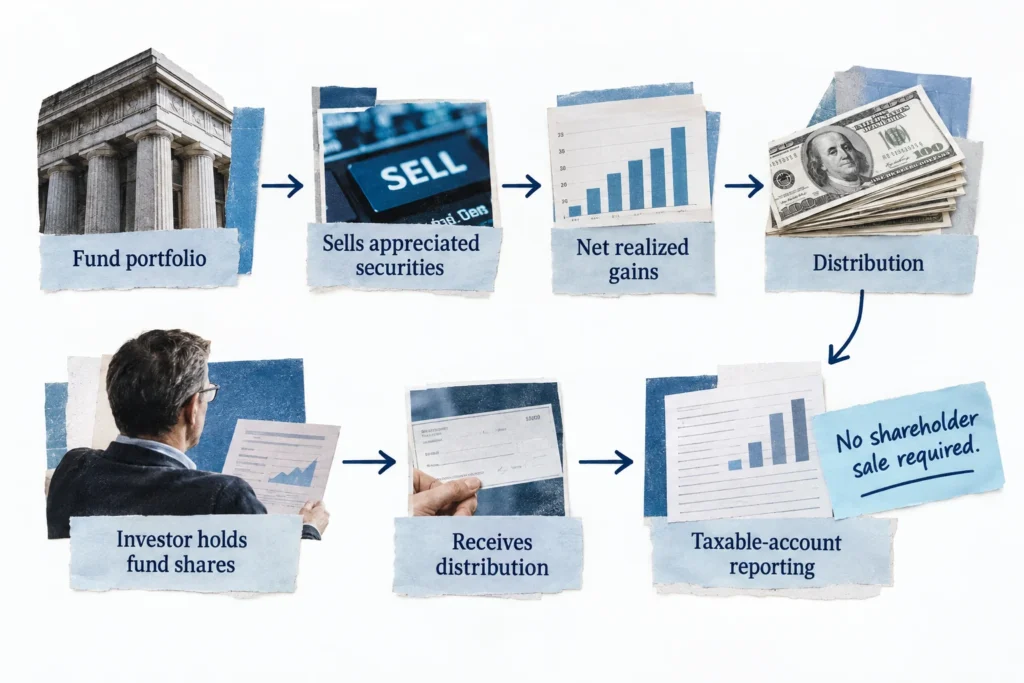
Imagine I’m scrolling through a downloaded brokerage file: no sales, a lower balance, and a line labeled “capital gain reinvestment.” I’m frustrated because there apparently is income to report with no way to pay the tax. Instead of trying to find the sale I didn’t make, I look at a distribution entry and a reinvestment entry side by side. The distribution entry records income and the reinvestment entry records the purchase. That is a good place to start.
The fund’s profit isn’t measured from your purchase date
Suppose a fund bought a stock years ago for $30. The stock starts this year at $100, falls to $70, and the fund sells it. It has fallen 30% this year, but the fund still realizes a $40 gain: $70 minus its $30 purchase cost. You might have bought the fund near the beginning of that decline. Your loss doesn’t erase the fund’s older profit.
Portfolio rebalancing to facilitate share repurchases will realize embedded gains. Gains can be offset by losses, and available loss carryforwards, meaning not all realized gains result in a distribution. Falling prices do not warrant that a fund has realized losses that can be used to offset its gains.
A long-term capital gains distribution that is designated will keep that character even if you recently purchased the fund. Distributed net short-term gains will be treated as ordinary dividends. Use the fund's purchase date to classify the payment. The tax character comes from the fund.
Where a $200 distribution actually goes
This example uses made-up numbers, but you can perform the calculation with a standard scientific calculator. You own 100 shares with an original cost basis of $2,500. Immediately before a $2-per-share long-term distribution, the fund’s net asset value, or NAV, is $20. Assume no market movement, fees, other distributions, or basis adjustments, and reinvestment at the adjusted $18 NAV.
| Account item | Calculation | Result |
|---|---|---|
| Value before distribution | 100 shares × $20 | $2,000 |
| Long-term distribution | 100 shares × $2 | $200 reportable |
| Original shares after NAV adjustment | 100 shares × $18 | $1,800 |
| New shares from reinvestment | $200 ÷ $18 | About 11.1111 shares |
| Total value after reinvestment | About 111.1111 shares × $18 | $2,000 |
| Aggregate cost basis | $2,500 original cost + $200 new purchase | $2,700 |
You haven’t gained an extra $200 of wealth. The distribution produces a corresponding NAV adjustment, and reinvestment puts your payment back into the fund. Take cash instead and you’d have $1,800 of shares plus $200 cash; reinvest and you have more shares worth the same $2,000 before tax. Market movement can obscure that adjustment on your actual brokerage screen.
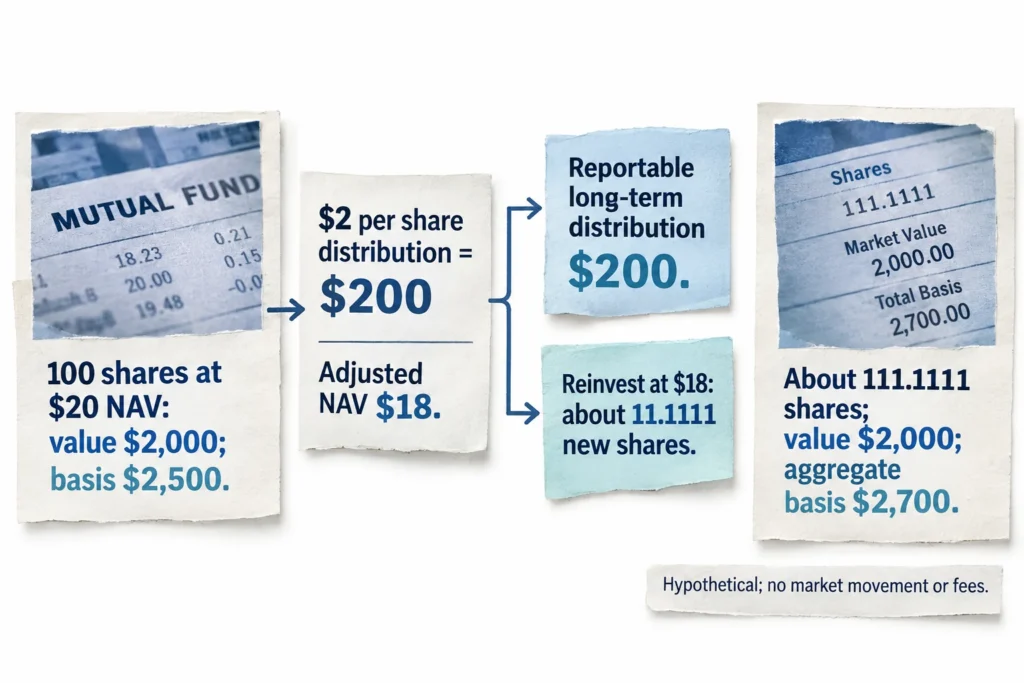
I would watch closely the new purchase. Those reinvested shares have $200 of acquisition basis and their own holding period, as explained in [IRS Publication 550](https://www.irs.gov/publications/p550). Your original shares maintain their original basis. Therefore, your total basis with respect to your two purchases would be $2,700 against a $2,000 value; thus, your basis would be $700 unrealized loss. However, your economic loss would be $500 with respect to your original $2,500 investment. The $200 of basis would be attributed to the distribution you are reporting and not to a subsequent decline in the value of your shares.
Just because an unrealized loss is reported on a screen, it does not mean that it is reportable for tax purposes. An unrealized loss does not offset a distribution for tax purposes. At a 15% federal rate, with no offsets, the loss would be $200, and reportable gain would be $30. Your actual additional tax could be different, including zero, because realized losses, a 0% capital-gains rate, and other household circumstances affect the result.
Match the payment, purchase, and tax form
An issuer’s estimate helps you plan for a coming distribution; it isn’t your filing number. The amount can change. Once the final notice arrives, use its per-share amount, tax classification, and eligibility dates to explain the payment. In our example, $2 of long-term gains multiplied by 100 eligible shares should match the $200 account entry.
Then look at the reinvestment record: $200 divided by $18 buys approximately 11.1111 shares with $200 of acquisition cost. Actual reinvestment may vary. If the shares are there but the cost is not, have your broker provide a reassignment to that purchase. Don’t wait to sell the shares to discover the missing basis. Missing basis can cause a gain to be reported larger than it was.
Form 1099-DIV covers the year, not just this payment. Under the [IRS instructions](https://www.irs.gov/instructions/i1099div), box 2a reports total long-term capital-gain distributions; distributed net short-term gains generally go in box 1a as ordinary dividends. Add up all relevant annual payments before comparing them with the form. A year-end notice can omit earlier payments, while a consolidated brokerage form can include other funds. Specialized box 2 gain categories are already included in box 2a, don’t add them a second time.
Use the official tax form, including any correction, for filing. A box 3 nondividend distribution is a different classification with different basis treatment. Capital-gain distributions generally flow through Schedule D, though some taxpayers with only eligible distributions can report them without it; the applicable filing-year instructions determine whether that exception fits your return.
Does waiting to buy help?
It can delay recognizing the distribution for a new $2,000 investment. With the no-market-movement assumption, you’d buy before the distribution to get 100 shares at $20. Reinvest the $200 payment to get approximately 111.1111 shares. Your total investment would be $2,200. You buy after the distribution adjustment to get approximately 111.1111 shares at $18. Your total investment would be $2,000 and you’d have no distribution payment.
Having a lower NAV than the before distribution price doesn’t mean it’s on sale. Both positions have $2,000 of exposure to the fund. You sell each position for $2,200. The before-distribution position has no net gain across its lots and the after-distribution position has a net $200 gain. Lots can still have a gain or loss and different holding periods. With identical applicable tax rates and no other considerations, the comparison is tax deferral.
I’d give a short delay for a planned purchase, expected to be material, using the fund’s actual eligibility date rather than the payment date. However, you’d also need to consider what the market is doing. Avoiding a distribution doesn’t ensure a better after-tax result.
The sale of an existing holding would raise tax issues of a different kind. A sale can of course realize a gain. However, if a loss is recognized, the sale of substantially identical shares within 30 days of the sale can give rise to wash sale rules. For fund shares held six months or less, a loss can also be treated as long-term to the extent of capital-gain distributions received. There can be important consequences when considering an exit as a tax-saving move.
If you hold the fund in a retirement account
Distributions retained in a traditional IRA or 401(k) usually don’t cause a taxable event to the fund shareholders, so the example used above for a taxable account doesn’t necessarily represent an immediate taxable event for the shareholders of the IRA or 401(k) funds. A distribution from a traditional IRA is taxable as ordinary income, and a distribution from a Roth IRA will be taxable if the withdrawal is not qualified.
A withdrawal from a taxable account will always be an income-producing event, and a distribution from a taxable fund will be taxable to the shareholder.
A large taxable distribution is not a failing fund or a gift from the fund. The fund may still be serving your investment needs. Reserving cash to pay the expected tax may allow you to defer the taxable realization of the investment.
Sources and references
- Internal Revenue Service: Publication 550 (2025), Investment Income and Expenses
- Internal Revenue Service: Instructions for Form 1099-DIV (01/2024) (2024-01)
- Internal Revenue Service: 2025 Instructions for Schedule D (Form 1040)
- Fidelity Investments: Understanding mutual fund taxes
- Fidelity Investments: Mutual Fund Distribution Estimates Q&A
- Fidelity Investments: Distributions by Fidelity Mutual Funds
- T. Rowe Price: 2025 Mutual Fund Year-End Dividend and Capital Gains Distributions
- Schwab Asset Management: Distribution and tax resources
- Internal Revenue Service: Mutual funds (costs, distributions, etc.)