

Not always. If you’re not an eligible designated beneficiary and the original owner died in 2020 or later, it may depend on the type of IRA the original owner had and the owner’s required beginning date. For a traditional IRA, if the owner died on or after that date, the IRA is subject to required minimum distributions (RMDs) for years 1-9. The IRA must be distributed by December 31 of year 10. A death before that date generally means no interim annual minimums under the ten-year rule. An inherited Roth IRA follows the same schedule.[1][2][3]
This is the distinction I’d want to settle before choosing investments or spending any money. “You have ten years” addresses only one of the two questions.
Which beneficiary category are you in?
A designated beneficiary is generally an individual. A surviving spouse is automatically a designated beneficiary. The “eligible” category may include the owner’s child who is under the age of 21, and/or an individual who is not more than 10 years younger than the owner. An adult child usually is not in the “eligible” category. A minor grandchild is not in the “eligible” category simply because of the grandchild’s age; the grandchild’s relationship to the owner must also be considered.[2][3]
| Your situation | Fact to confirm | General payout schedule |
|---|---|---|
| Traditional IRA | Owner died before the required beginning date | No interim annual minimums. Empty by December 31 of year 10. |
| Traditional IRA | Owner died on or after the required beginning date | Annual life-expectancy minimums in years 1-9 while assets remain. Empty by December 31 of year 10. |
| Roth IRA | Account type and original owner's death year | No interim annual minimums. Empty by December 31 of year 10. |
| Eligible designated beneficiary other than a spouse | Relationship, age, qualifying condition, and payout election | Life-expectancy payouts generally available. The owner's minor child generally enters a ten-year period at 21. |
| Surviving spouse | Ages, ownership choice, and elections | Own-IRA treatment or special beneficiary options may apply. |
| Trust, estate, charity, successor, multiple beneficiaries, or pre-2020 death | Beneficiary documents, death dates, account separation, and prior schedule | Separate analysis needed. Don't assume the ordinary ten-year schedule. |
Imagine I'm opening beneficiary paperwork beside a statement labeled only “inherited IRA.” I’ve set aside twenty minutes, but the owner’s birth and death dates aren’t listed. I don’t like that the statement sounds like it’s a answer, when in reality it’s not. Instead of selecting a withdrawal amount, I would ask for those dates and the beneficiary designation next. The distribution records would come next, to determine what has already been paid out to see when the owner’s RMDs began to be legally mandated.
April 1 can matter more than the owner's age
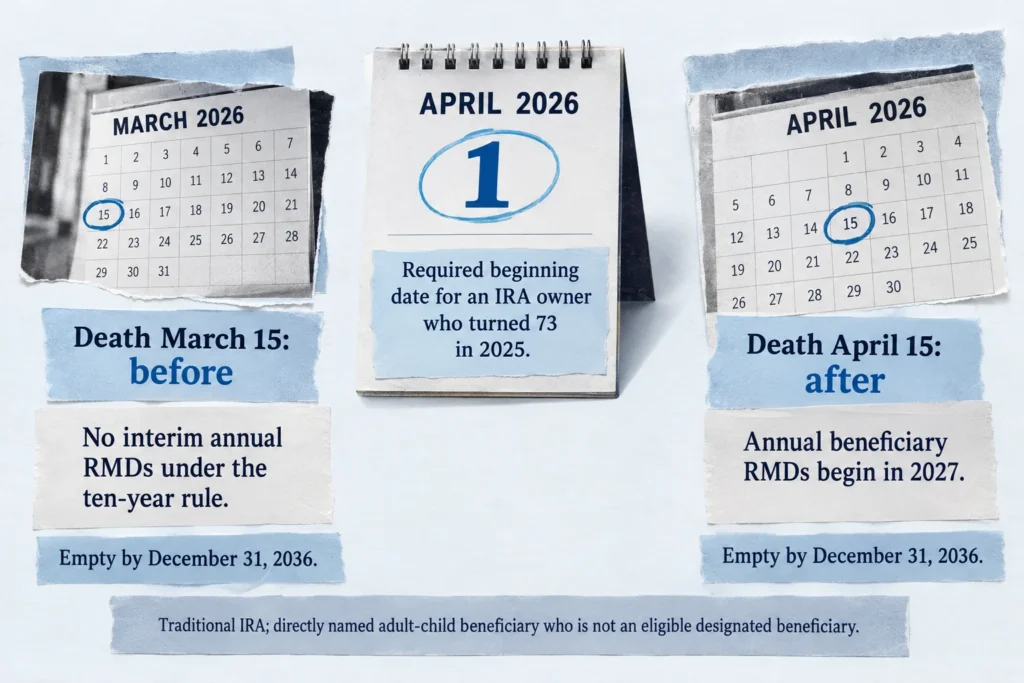
The actual calendar date is what determines the required beginning date, not when the owner took their first distribution from the account, or what age it was relevant to the owner. For an owner who turned 73 in 2025, it’s April 1, 2026. Taking withdrawals earlier does not impact this date.[1][2]
Suppose you're that owner's ordinary adult-child beneficiary. If your parent died on March 15, 2026, the traditional IRA falls into the no-interim-minimum branch. If the death was April 15, annual beneficiary RMDs begin in 2027. Either way, the account must be empty by December 31, 2036. This is why I'd check the actual date rather than settle for “they were already 73.”[1][2]
The annual minimum isn't one-tenth of the account
Here's an illustrative calculation: your parent died in 2025 after the required beginning date, named you directly as beneficiary, and left a traditional IRA worth $362,000 on December 31, 2025. You turn 50 in 2026 and aren't an eligible designated beneficiary. The IRS Single Life Table factor for age 50 is 36.2, so your 2026 minimum is $362,000 ÷ 36.2 = $10,000, due by December 31, 2026.[1][2]
In this example, the divisor generally decreases by one each subsequent year, with each calculation using the preceding December 31 balance. Annual minimums continue through 2034 if assets remain; the remaining balance must come out by December 31, 2035. I wouldn't mistake that $10,000 first minimum for a plan that steadily empties the account. It satisfies one year's floor, not the final deadline.[1][2]
Old relief doesn't erase today's annual requirement
If you've found older advice saying annual withdrawals were waived, check which years it covers. IRS transition relief covered specified missed beneficiary distributions for 2021-2024. The final regulations apply starting with 2025 distribution calendar years, so that relief neither restarts your ten-year clock nor excuses ordinary annual RMDs for 2025 or 2026. Announcement 2026-7 addresses future regulations associated with separate proposals, not an extension of this beneficiary relief.[2][4][5]
Make sure to look and see if the owner left an unfinished year of death RMD. The final regulations give an automatic tax-exemption for a distributor to make a corrective distribution within a special window: the later of the beneficiary’s tax return due date for the year of death, plus extension, or the end of the next year.[1][2]
If you've missed an annual minimum distribution, calculate the shortfall and take the corrective withdrawal as soon as possible. The excise tax is typically 25% of the shortfall, but can be reduced to 10% through timely correction. A reasonable-error waiver can be found on Form 5329; however, forgiveness is not automatic. Be sure to keep the calculation, distribution confirmation, and explanation of your error.[6]
Choose the tax pace after you know the minimum
Traditional IRA distributions are generally ordinary, taxable distributions. However, if your IRA contained a nontaxable basis, that part would not be taxable. Waiting until year ten can bunch income into one tax year; taking more than the minimum earlier may help, particularly in lower-income years. Though, equal annual withdrawals may still be the cheapest option in the long run. It really depends on the other income you are likely to have at retirement and your cash withdrawals.[1]
With an inherited ordinary Roth IRA, you do not have an annual minimum distribution requirement. This means you have more control over the timing of your distributions. Qualified distributions are tax-free. Keep in mind that the five year qualification period for the owner also applies after they have passed. That is why, even though there is a ten year payout period, the payout period can still begin before it.[1][7]
One mistake I'd head off before you move the money: As a nonspouse beneficiary, don't expect to be able to roll over an distribution to yourself and place it in an inherited IRA. The 60-day rollover doesn’t apply to you. If you need to move the account without treating the transfer as a distribution, use a direct trustee-to-trustee transfer to a properly titled inherited IRA.[1]
Have the beneficiary designation, owner's birth and death dates, account type, prior December 31 balance, and distribution records ready when you ask the custodian: “Which beneficiary category are you using, what amount and divisor apply this year, and what's my final payout date?” I want to have these answers in writing. I would place required minimum distributions (RMDs) and other tax-planning withdrawals on separate calendar lines. “Ten years” still does not answer this year’s RMD question.
Sources and references
- Internal Revenue Service: Publication 590-B (2025)
- Department of the Treasury and Internal Revenue Service: Required Minimum Distributions, T.D. 10001 (2024-07-19)
- Internal Revenue Service: Retirement topics, Beneficiary
- Internal Revenue Service: Notice 2024-35
- Internal Revenue Service: Announcement 2026-7
- Internal Revenue Service: Instructions for Form 5329 (2025)
- Legal Information Institute, Cornell Law School: 26 CFR § 1.408A-6, Distributions