

Yes, a low-income year can be a good time for a partial Roth conversion. However, I wouldn't deliberately try to fill a tax bracket just because the space is available. Look at no conversion as the baseline, and then compare against at least two conversion amounts across a few years. A conversion is worthwhile if the additional taxes and insurance costs are less than the taxes the money would face in the future, and it leaves enough spending money.
Picture me at the kitchen table happy about a spreadsheet showing available space in the 12% bracket. Next, I put the estimated conversion tax next to the cash set aside for next year's expenses. That extra payment suddenly becomes less abstract. I don't abandon the idea. I create a smaller conversion and a no-conversion column. I prefer to use the window intentionally than to turn it into another cash obligation.
The conversion dollars sit on top
Ordinary income from conversion is taxed at the highest ordinary income tax rate for that year. A conversion doesn't get a special tax rate. With other retirement income and withdrawals, you’ve already used a portion of your tax bracket, and the conversion may simply increase the tax you owe. If you have nondeductible IRA contributions, Form 8606's basis calculation can reduce the taxable portion; you generally can't isolate that basis by converting just one IRA.[2][3]
Here's a controlled comparison. Both spouses turn 60 in 2026, file jointly, and have $1 million in entirely pretax IRAs. They receive a $60,000 annual pension, spend $80,000 before income taxes, and start with $180,000 of accessible cash. They have retiree medical coverage, no Social Security yet, and no other income. Conversion taxes come from that cash, not from the IRA.
For 2026, the joint standard deduction is $32,200. The 10% bracket ends at $24,800 of taxable income, and the 12% bracket ends at $100,800. Thus, the household has $27,800 of taxable income, and a federal income tax liability of $2,840, before conversion. To isolate the effect of conversion, I will keep these tax parameters, pension and spending the same for the next 3 years. I am not predicting these tax parameters for the future, but rather making an assumption for the purposes of comparison. State taxes, investment income, credits and cash interest are ignored.[1]
| Measure | No conversion | $30,000 each year | $80,000 each year |
|---|---|---|---|
| Total converted over three years | $0 | $90,000 | $240,000 |
| Annual taxable income | $27,800 | $57,800 | $107,800 |
| Annual added federal tax | $0 | $3,600 | $10,300 |
| Three-year added federal tax | $0 | $10,800 | $30,900 |
| Average federal tax on converted dollars | Not applicable | 12% | 12.875% |
| Accessible cash after three years | $111,480 | $100,680 | $80,580 |
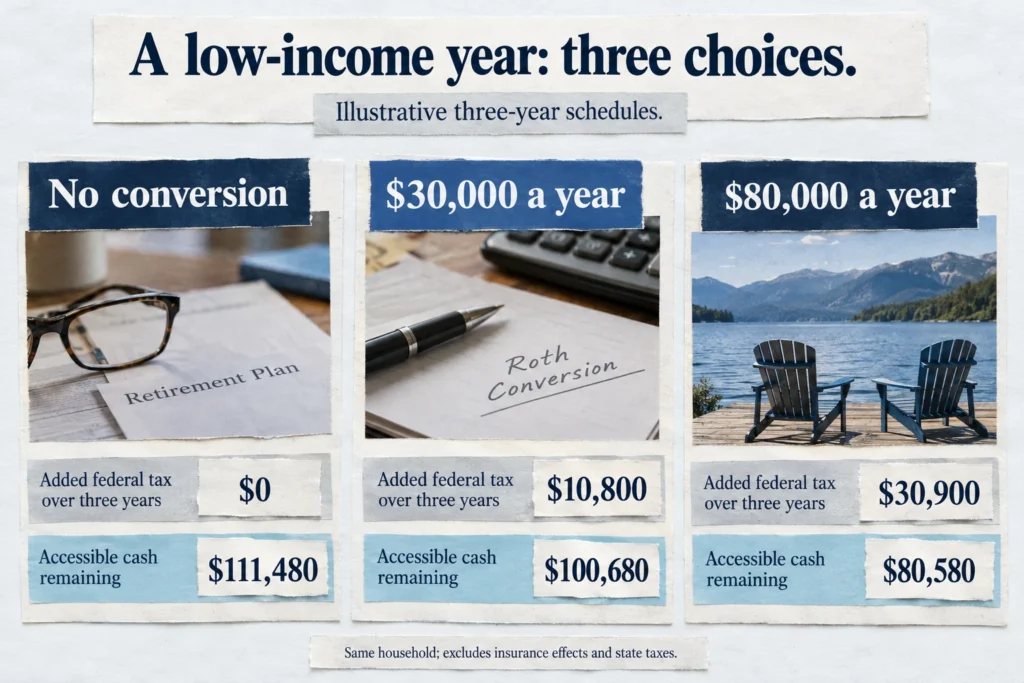
The cash calculation is $180,000 minus three years of the $20,000 spending gap and $2,840 baseline tax, minus conversion taxes. The larger of the two schedules has $30,900 less cash available to spend than the no conversion case. Whether $80,580 is enough depends on what that reserve must cover; a tax calculation can't answer that for you.
Notice the price of going bigger. Moving from $30,000 to $80,000 costs another $6,700 annually for another $50,000 converted: 13.4%, not 12%. The final $7,000 enters the 22% bracket. I care more about that added cost than the household's average tax rate, because it's the extra conversion we're deciding whether to buy.[1]
A smaller future RMD isn't the whole payoff
For people with birth years of 1960 or later, RMDs commence at age 75. Assume the couple’s IRA earns 5% annually. Conversions occur at the start of three successive years with no IRA distributions prior to age 75. Using 15, 14, and 13 years of growth for those conversions, the projected pretax balances are approximately $2.079 million, $1.901 million, and $1.603 million. Applying the age 75 divisor of 24.6, the estimated RMDs would be $84,500, $77,300, and $65,200.[4][5]
Those declines are significant but don’t prove the conversion was prudent. You prepaid tax. You also gave up the opportunity cost of what that payment could have earned. If you take IRA distributions to fund your spending prior to age 75, the balance and eventual RMDs will be smaller than shown in this example.
We’ll discount the tax rate assumption by granting the retained tax payment money and the after-tax growth of the retirement money the same 5% growth. Different from the cash-reserve table, we’ll let the tax money grow. At age 75, the smaller schedule has moved $178,335 to a Roth IRA and the larger has moved $475,561. The tax payment opportunity costs are $21,400 and $61,228. The advantage is the tax that is saved on the conversion and the opportunity cost of that payment.
- At a 12% future withdrawal tax rate, the smaller schedule trails by about $4,200. The larger schedule trails by no conversion.
- At a 22% future withdrawal tax rate, the smaller schedule leads by about $17,800 and the larger leads by about $43,400.
- At 32%, the respective advantages are about $35,700 and $91,000.
This is not a long-term projection, so it doesn’t factor in insurance protection and assumes a consistent tax rate in the future. More growth magnifies dollar differences and doesn’t change the break-even points. If after-tax earnings on retained money, after the tax on the earnings is paid, are less than the earnings on Roth money, and if paying taxes leaves too little cash to spend, it’s better to leave the money in the Roth. Conversely, if the after-tax money on the retained earnings earns more than the Roth earnings, it may be better to take the money from the Roth. I would rerun the analysis, but using less favorable assumptions, like lower returns and greater spending.
Health coverage can change the answer
The amount of income used by different programs varies. Medicare's income-related premium adjustment, or IRMAA, generally uses adjusted gross income plus tax-exempt interest from two years earlier. In the Marketplace, household MAGI uses income from the coverage year and removes tax-exempt interest and Social Security, and any foreign income that was excluded from income. When calculating combined income for Social Security, other income, and tax-exempt interest are always added. A standard deduction doesn't reduce these the way it does for taxable income.[6][8][11]
For Medicare enrollees, a 2026 conversion ordinarily affects 2028 premiums, not 2026 premiums. The 2026 joint IRMAA threshold is $218,000, but that's not a known 2028 threshold. Our age-60 couple isn't yet on Medicare; the lookback becomes relevant as conversions approach age 63. Add any extra Part B and Part D premiums for each affected spouse to the conversion cost. Crossing a threshold isn't automatically a mistake, but ignoring the resulting bill is.[6]
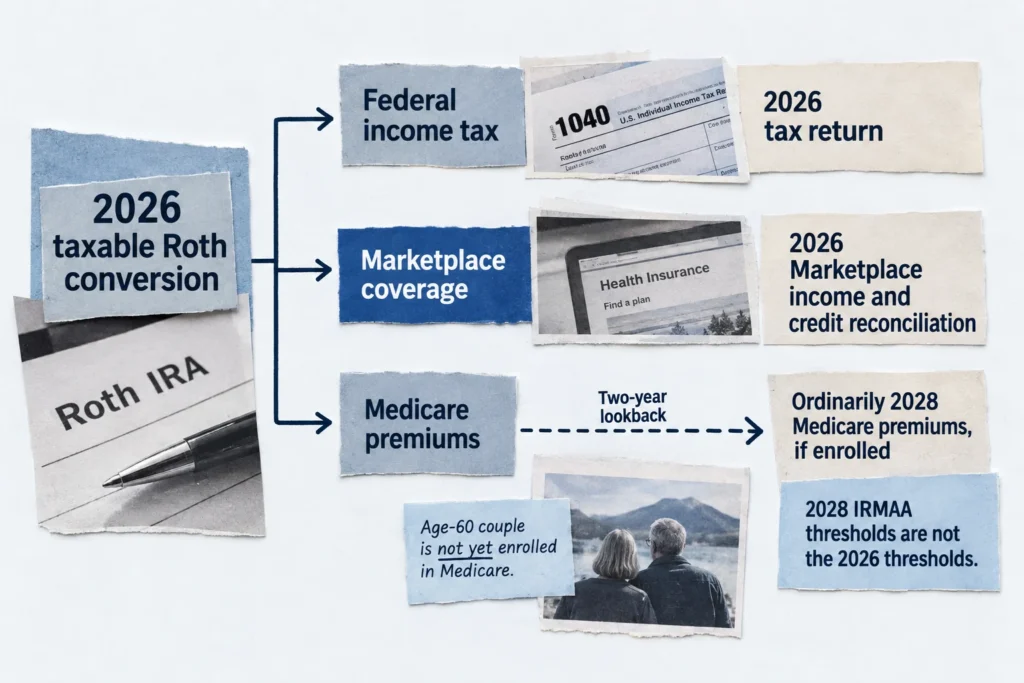
Retirement or work reduction can be filed with an SSA-44 to request reconsideration of an income-related adjustment. A Roth conversion alone doesn’t qualify as a listed life-changing event and being granted reconsideration doesn’t negate the impact of the conversion. Therefore, I’d include the conversion income in any estimate and assume the surcharge won’t be removed.[6][7]
Now replace the couple's retiree coverage with Marketplace insurance. Their household MAGI becomes $60,000, $90,000, or $140,000. Under 2026 federal rules, premium-tax-credit eligibility generally ends above 400% of the applicable poverty guideline: $84,600 for a two-person household in the contiguous states and DC. Both conversion schedules cross it. Income alone can't tell us their credit, but if the no-conversion credit were $8,000, losing it would raise the smaller conversion's annual tax-and-credit cost from $3,600 to $11,600. That changes the comparison completely.[8][9][10]
In that branch, test an amount below the $24,600 gap between baseline MAGI and the credit ceiling, leaving room for unexpected income. Even below the ceiling, a conversion can reduce assistance. Update the Marketplace income estimate when converting; federal excess advance-credit repayment caps no longer apply after 2025, so underestimating income can leave a substantial reconciliation bill.[8][9]
Once Social Security starts, rerun the tax calculation
Up to 85% of Social Security benefits can be included in taxable income; that's not an 85% tax rate. With the example's $60,000 pension and $40,000 of benefits, the couple already reaches that inclusion cap before converting. But consider a lower-income joint household with $20,000 of other income and $40,000 of benefits: the IRS worksheet produces $4,000 of taxable benefits. A $10,000 conversion increases taxable benefits to $11,100, creating $17,100 of additional taxable income, not just $10,000.[11][12]
A surviving spouse may also face single-filer brackets. On the other hand, in high-income years it may be advantageous to convert traditional IRA money to a Roth IRA, but this is also dependent on your household's after-tax income. After-tax income should also be considered when deciding if it is advantageous to take distributions from the traditional IRA. The original owners of Roth IRAs are not required to take RMDs. Flexibility is also important when considering household after-tax income.[4]
Choose this year's amount, not a permanent commitment
Keep in mind the projected tax return when moving money. Convert the price of that conversion for state taxes, capital gains and any age-related phaseouts. Form 8606 shows the basis. Identify the cash to pay the taxes and spend. A direct trustee-to-trustee conversion avoids a cash distribution but you need to factor in estimated tax payments and withholding. Conversions made in 2018 and after cannot be reversed by recharacterization, and an RMD cannot be converted.[2][3]
If you're under 59½ or will need Roth money soon, check the applicable five-year and distribution rules before treating the converted balance as freely spendable. In this case, I would be carrying the $30,000 and $80,000 scenarios forward as possibilities and not as actual decisions. Factors such as a lower withdrawal rate, loss of insurance subsidy, and/or thinner spending cushion would push me more toward less or none. Larger withdrawal taxes, and ample tax cash would push more toward a higher withdrawal rate. Keep the money available until next year when income and cash outflow needs are better known.[4]
Sources and references
- Internal Revenue Service: 2026 federal tax inflation adjustments (2025-10-09)
- Internal Revenue Service: Publication 590-A (2025)
- Internal Revenue Service: Instructions for Form 8606 (2025)
- Internal Revenue Service: Publication 590-B (2025)
- Thrift Savings Plan: RMDs: What to know, when to know it
- Social Security Administration: Medicare premiums
- Social Security Administration: SSA-44, Medicare Income-Related Monthly Adjustment Amount, Life-Changing Event
- HealthCare.gov: What's included as income
- Internal Revenue Service: Premium Tax Credit overview
- HealthCare.gov: Federal poverty level
- Internal Revenue Service: Publication 915 (2025)
- Social Security Administration: Retirement Benefits