

I’d favor an FDIC-insured high-yield savings account if deposit protection is a requirement for your emergency fund. A government or Treasury money-market mutual fund can work for reserves you can afford to wait to withdraw, provided you accept that fund shares aren’t insured deposits. Either way, keep enough already-accessible cash to pay expenses that could arrive before a transfer finishes. An online savings balance isn’t necessarily Saturday spending money, either.[1][3][5][6]
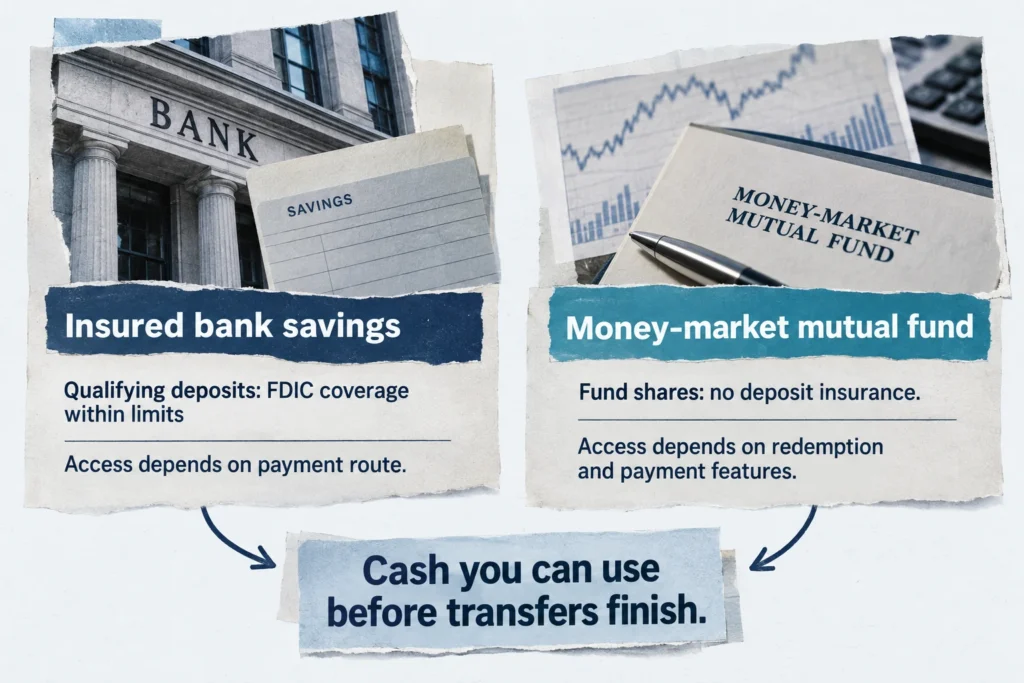
Picture me in an imagined Friday-evening predicament: it’s 8 p.m., a repair requires $2,000 on Saturday, and my cash balance looks comfortably large. Then I find the transfer screen’s business-day language. I’m annoyed, not at the yield, but at having counted money I can’t yet pay with. I’d keep a reachable payment cushion rather than ask the next repair to respect banking hours.
Similar names, different protection
First, a small naming trap: a bank money-market deposit account is a deposit, like savings. A money-market mutual fund holds investments. The words “money market” don’t tell you which protection applies.[1][3]
FDIC insurance covers qualifying deposits up to $250,000 per depositor, per insured bank, per ownership category. That isn’t a fresh allowance for each account. For example, $240,000 in single-owner savings plus $20,000 in single-owner checking at the same bank, both without beneficiaries, totals $260,000 in that category, leaving $10,000 above the standard limit. Count your other deposits before treating the entire emergency balance as covered.[1]
SIPC provides protection for customer cash and securities held by a member brokerage in the event of a failure for losses up to $500,000 (including $250,000 for cash). SIPC does not cover investment losses, and does not guarantee that you will be able to recover your investments. I would not rely on a larger headline coverage number in place of deposit insurance.[2]
Government and Treasury money-market funds attempt to keep a share price of $1. There is no guarantee. The funds generally invest in short-term investments and have different risks from funds that invest in corporate obligations. In an emergency, I would prefer short-term money-market funds rather than reaching for an extra yield and potentially risking principal.[3]
Can the balance actually pay your bill?
I would compare how you will pay the bill rather than where the cash is located. Money-fund shares that are liquid may still need to be sold. There are expenses and delays to selling, and then potentially an additional expense and delay to transfer the funds. Some brokerage accounts perform these operations seamlessly, while others do not.[4][5][6][7][8]
| Payment route | Published timing or feature | Friday 8 p.m. request for a Saturday payment |
|---|---|---|
| Ally savings → existing Ally spending account | Internal transfers are immediate. | Potentially workable with available funds, an existing payment method, and sufficient limits. |
| Ally savings → external bank | Standard transfers take three business days. Eligible next-day transfers have a 7:30 p.m. ET cutoff. | Not a Saturday solution through this transfer route. |
| Manually sold fund → Fidelity withdrawal → external bank | Redemption availability comes first. Fidelity generally quotes 1-3 business days for EFT; same-business-day wires require submission before 4 p.m. ET. | The business-day transfer routes do not meet Saturday’s deadline. |
| Existing Fidelity cash management account → direct payment | Debit-card and check features can avoid an external bank transfer. | Potentially workable if already enabled and funded, with sufficient available balance and payment limits. |
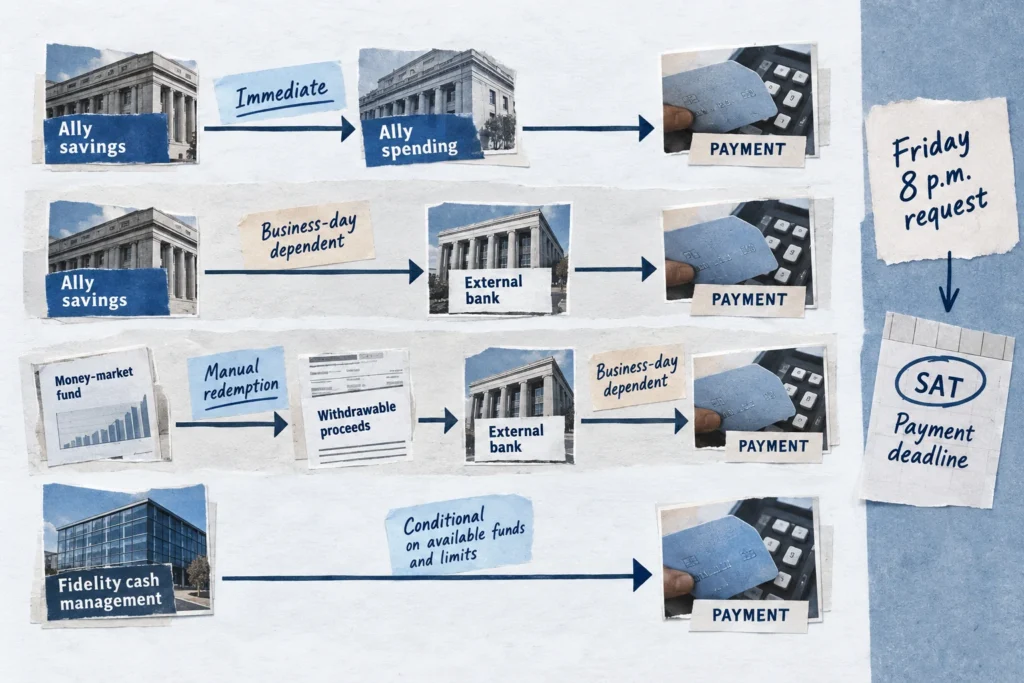
“Next day” is doing a lot of work here. Weekends, holidays, and missed cutoffs can push processing into another business day, and Ally’s next-day option depends on your account’s eligibility. Fidelity’s same-business-day wire requires withdrawable funds and established wire instructions. A bank linked for EFT isn’t automatically set up for wires, and the receiving bank may affect availability or charge a fee.[5][6]
I wouldn't add an extra settlement day to every money market fund withdrawal. Fidelity describes its redemption process in its fund prospectus, where it states that redemption proceeds are made available on the next business day, or earlier. Its “cash available to withdraw” includes money market funds, but not uncleared deposits. That’s why, in some instances, a manual fund sale and subsequent core position spending may have different time frames.[4][7]
In your account, look at your “cash available to withdraw,” and then compare it to the bill and your payment method limitation. If you need to make a transfer, look for the next eligible processing date, rather than the range where the funds are advertised to be delivered. Direct brokerage spending is convenient, but it doesn't provide FDIC insurance on fund shares. I don't know from the public timings if your funds are on hold, or subject to a security review.[6][7][8]
Give the yield difference a dollar value
Compounding is factored into a savings account's APY. The yield quoted for a money market fund is for the most recent 7-day period. Fidelity displays a fund's yield after fund expenses. Neither the yield, nor savings account rates, are guaranteed for the following year. Savings account rates, and money fund yields are variable.[3][9][10]
Subtracting a seven-day yield from a savings APY won’t give you a precise annual advantage because the figures handle compounding differently. Compare your matched annual returns if they are close. Account for taxes, fees and other factors as well. I’d much rather know what increased purchasing power can get me before asking me to maintain yet another account.[6][9][10]
A small accessible layer may resolve the choice
Size a layer of your reserves around your best guess expense coverage during your verified transfer window, including overlapping expenses. Suppose your reserve is $25,000 and $3,000 covers your best guess of near term exposure. You can keep the $3,000 in your existing spending setup and place the remaining $22,000 in an FDIC-insured savings or money market fund. This is a household calculation, not an advised percentage.
If one option gave you a hypothetical 0.40 percentage point advantage on a matched annual return, that $22,000 would earn about $88 for the year, $22,000 X 0.004. Again, assume this is after taxes. It’s not enough to disrupt your payment flow.
If your current savings setup gives you the coverage and gets your payment flow, I’d leave it alone. If your brokerage fund covers your payments, adding safe savings may give you better protection, not speed. You don’t need another account just because there’s another yield.
Sources and references
- Federal Deposit Insurance Corporation: Are My Deposit Accounts Insured by the FDIC?
- Securities Investor Protection Corporation: What SIPC Protects
- U.S. Securities and Exchange Commission: Money Market Funds: Investor Bulletin (2024-11-04)
- Fidelity Investments: Fidelity Government Money Market, Money Market, and Treasury Only Money Market Funds prospectus (2026-06-29)
- Ally Bank: Transfers: What to Expect
- Fidelity Investments: How to choose between an EFT or a bank wire
- Fidelity Investments: Trading FAQs: About Your Trading Account
- Fidelity Investments: Cash Management Account and FAQs
- Fidelity Investments: Earn a competitive rate on your uninvested cash
- Ally Bank: Ally Bank Savings Account