
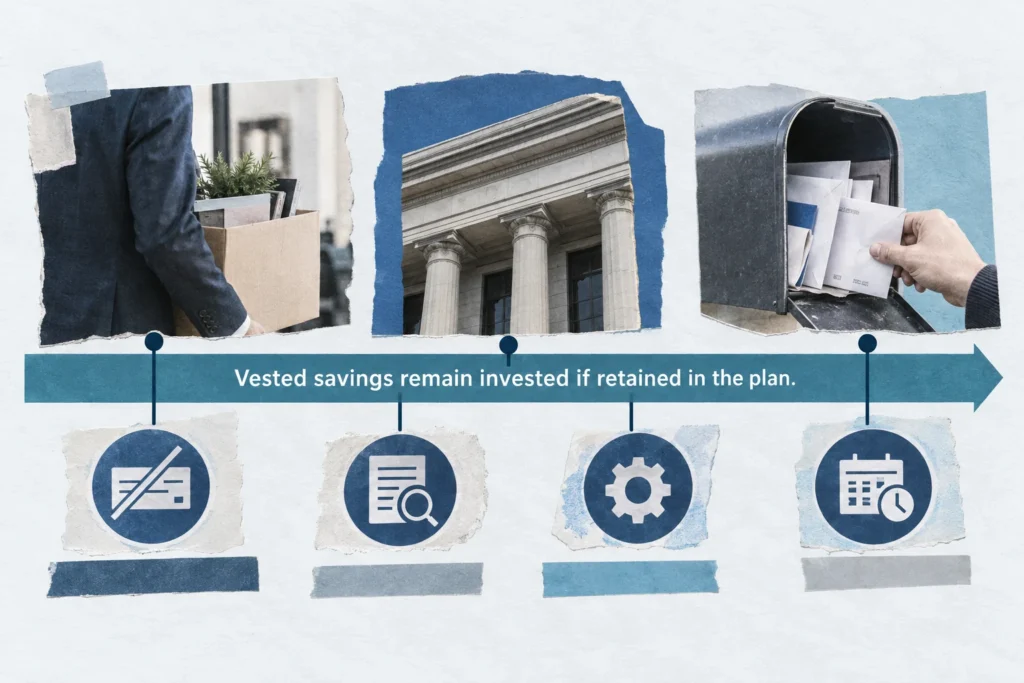
Normally, leaving your job doesn't sell your investments in your 401(k). It doesn't take away your vested money either. If the money remains in the plan, it is invested and can potentially decrease in value. It may be better to leave the money where it is, but you should pay attention to small balance distribution notices and/or outstanding loans after you leave.
I am okay with people keeping a good old plan, but worrying about managing the money is a different issue. Saying "I'm leaving the investments alone" is not the same as "I can stop opening the mail."
Right after you leave: ownership stays, payroll activity changes
The investments you have made in the plan (along with their earnings) are fully vested and are yours. Look for “vested balance” (not “total balance”) on your statement to check how much of the employer money is fully vested. If the plan’s rules say the employer money is forfeited, it is possible that the money is not fully vested, and it could be taken back by the plan, but don’t assume this, especially with the timing of it happening.
Ongoing payroll contributions generally end when eligible pay ends. A final paycheck contribution or later employer contribution may still arrive, depending on compensation and plan terms. That's separate from managing money already there: you can generally continue choosing among the plan's investments, subject to its rules. Access to new loans or other employee services may change.
Picture me, in an imagined job-transition evening, trying to open the old benefits portal after my work email has been shut off. I am being dramatic: the balance is visible in a saved statement, but the email reset doesn't work. I get the balance access back, and replace the email. I'll get to the access when I get to the investment decision.
A small balance may not be allowed to stay
Federal law permits a plan to adopt involuntary distributions for applicable balances of $7,000 or less. It doesn't require every plan to use $7,000, or to adopt this provision at all. Find your plan's rule in its summary plan description, amendments, and separation notice, searching for “mandatory distribution,” “involuntary distribution,” or “automatic rollover.”
| Plan's adopted cash-out limit | What the same $6,500 balance means |
|---|---|
| $5,000 | The balance exceeds this small-balance provision; it cannot be forced out under that provision. |
| $7,000 | The balance falls within this provision; no election can result in an automatic IRA rollover. |
The endpoints matter. For an involuntary eligible distribution above $1,000 and within the plan's adopted limit, the plan must generally send the money to an IRA if you don't elect another treatment. Exactly $1,000 isn't above $1,000; a plan may instead pay that amount directly to you. Exactly $7,000 falls within a provision using the full federal ceiling.
One wrinkle: plans may exclude prior rollover contributions and their earnings when testing the balance. CBRE's September 2025 plan document expressly includes rollover contributions, showing why your headline account total doesn't settle this by itself. And if you encounter $5,000 in general guidance, that may reflect an older legal limit or a plan that still uses it. The IRS's 2025 Publication 560 states the current $7,000 ceiling.
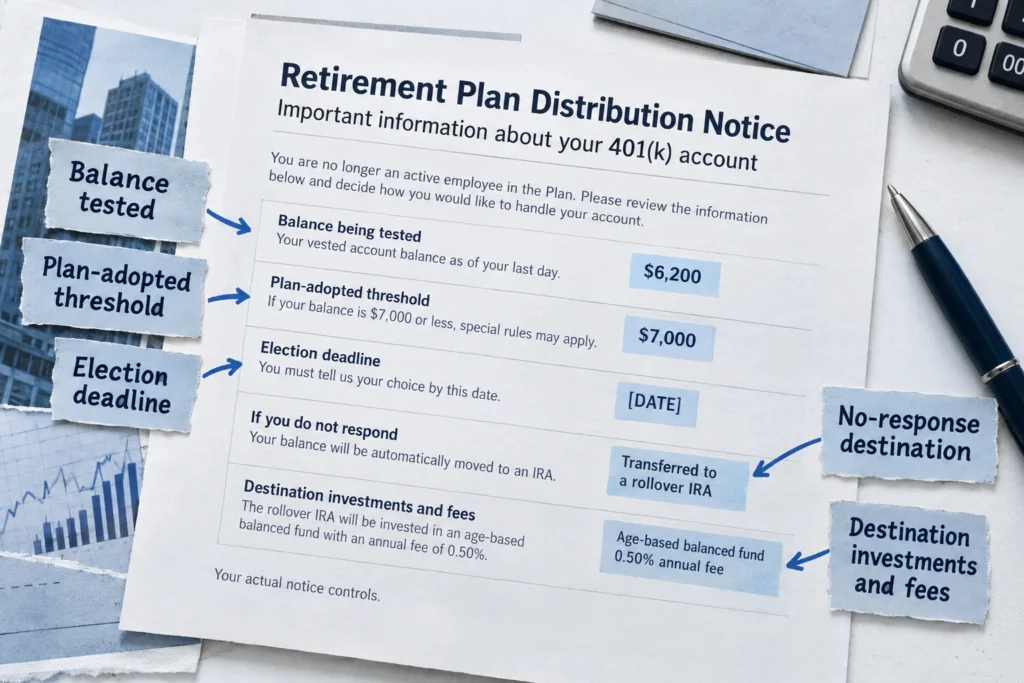
I read five things on a distribution notice: the balance being tested, the adopted threshold, the election deadline, where the money goes if I don’t respond, and the destination’s investments and fees. Not every plan uses the same number of days after the date of leaving to set a distribution deadline. Put the actual notice deadline on your calendar.
An automatic rollover preserves an account, not necessarily your portfolio
Automatic rollovers of IRAs to other IRAs generally are tax-advantaged changes of investment. For example, the provided Richey May summary plan description has provisions for automatic-portability to a participant-paid IRA with principal-preservation investing. This is different from retaining your stock and bond funds. A subsequent plan of a participating employer can accept the automatic rollover from the plan of the former employer.
Don’t think that a distribution in the form of a check means the plan has adopted a housekeeping approach to your account. A check you receive generally means that 20% federal income tax has been withheld and isn’t your final tax bill. You generally have 60 days to roll it over, and rolling over the full amount requires replacing the withheld money. A direct rollover avoids that withholding. Money you retain may be taxable and may face an additional early-distribution tax unless an exception applies.
Over time, the plan can change around you
Just because you stay with a plan, this doesn’t ensure the plan doesn’t change its recordkeeper, funds, or costs. For example, funds may be replaced with other funds. Administrative terms may change. Read notices to understand what is changing, and when the changes occur.
I wouldn't assume former employees automatically pay more. First check if the employer subsidy ends or a former participant charge applies. Also separate statement deductions from investment expenses. An administrative charge may appear as a dollar debit, while a fund's operating expense reduces its returns. Visible debit doesn't necessarily mean expense, and fees charged should not be counted twice.
- Upon separation, recover independent login, change the mailing address on the company record to your personal address, change your email address and phone number, update beneficiaries, save a copy of your vested balance statement, a copy of the plan description and your separation packet.
- Be on the lookout for unexpected changes to your account. In a self-directed account, watch for un-expected changes to your holdings, trades and expenses. Investment-directed plans usually provide quarterly statements.
- Look over the plan's fee disclosure. Review investment options and consider other retirement plan options. Review your beneficiaries after major life events. Plan beneficiary changes may require spousal consent.
- Whenever a notice arrives: check its deadline and no-response outcome, especially for distributions, investment replacements, blackouts, and plan termination. Retain distribution confirmation, your plan rollovers, tax form 1099-R and other Plan documents.
Two situations where waiting needs a closer look
An outstanding plan loan requires prompt action. See if repayments can continue after separation. Find out how to make payments without payroll deductions and the due date before the loan defaults and your account is offset. Account offsets reduce the amount in your account to pay off the loan, and may create a taxable distribution. Account offsets in connection with a qualifying separation from service allow you to extend the rollover deadline to the date of your federal income tax return for that year, including extensions, but you would need other money to replace it. Not all defaults qualify for this treatment.
Later, required minimum distributions can end the option of leaving everything untouched. The starting age depends on your birth year. Working for a different employer doesn't preserve the old plan's still-working postponement, and required distributions can't be rolled over. Designated Roth 401(k) accounts have no required minimum distributions during the owner's lifetime.
If your plan’s investments and costs still work for you, remaining in the plan can be a good choice. Before leaving the plan, I would get a concrete answer to a question from the plan administrator. The question would be, “Under my current plan terms, can this vested balance remain here, and what event or deadline would change that?” Along with that answer, I would also keep the notice I was given at the time the plan vesting was determined. Then I could leave my investments alone.
Sources and references
- Internal Revenue Service: Publication 560 (2025), Retirement Plans for Small Business
- Internal Revenue Service: Retirement topics, Vesting
- U.S. Department of Labor: Meeting Your Fiduciary Responsibilities
- U.S. Department of Labor: A Look At 401(k) Plan Fees
- Richey May: The Get Richey if you May with our 401k Plan, Summary Plan Description
- Internal Revenue Service: Rollovers of retirement plan and IRA distributions
- Internal Revenue Service: Plan loan offsets
- Internal Revenue Service: Retirement plan and IRA required minimum distributions FAQs
- CBRE; filed with the Securities and Exchange Commission: CBRE 401(k) Plan, as amended and restated September 30, 2025 (2025-09-30)